The Bell Rang. Now What?
Everyone wanted in at K195.
The market opened on Monday morning and immediately said something different.
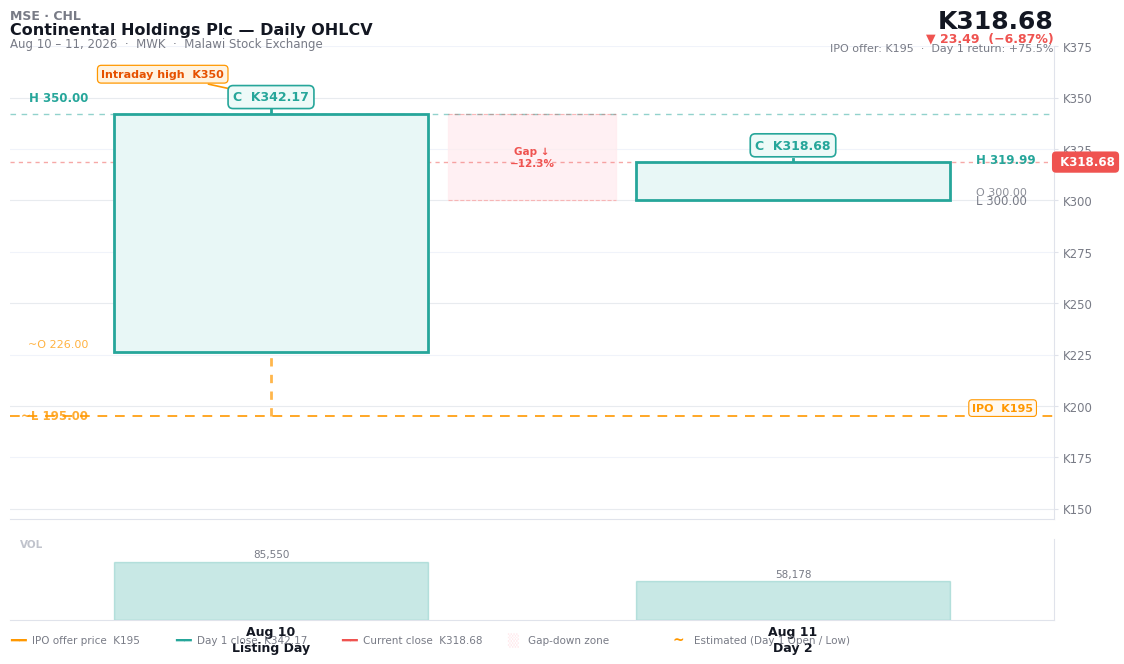
By noon, CHL was trading at K226. The share touched K350 intraday — then settled to an official Day 1 close of K342.17, a 75.5% return from the IPO price. Then Tuesday came. The price pulled back 6.87% to K318.68, with 58,178 shares changing hands.
Two days. Two very different numbers. And more than 10,000 shareholders who now face a decision that matters far more than the one they made when they submitted their application form.
Buying into an IPO feels like a decision. It isn’t. The real decision is what you do after the bell rings.
What Just Happened — In Plain Terms
Continental Holdings Limited listed on the Malawi Stock Exchange on August 10, becoming the 17th counter on the exchange and ending a six-year listing drought that began with FDH Bank in August 2020.
The IPO raised MWK 135.4 billion. Of the 753.3 million shares on offer, 701.8 million were subscribed — a 93% uptake. Every valid application was allotted in full. No rationing. More than 10,000 individual and institutional investors became shareholders on Day 1.
The offer price was MWK 195.
The market closed Day 1 at MWK 342.17 (touching K350 intraday).
The market closed Day 2 at MWK 318.68.
These are not three random numbers. They are three different answers to the same question: what is Continental Holdings worth? The offer said K195. Day 1 buyers pushed it to K342 on the close. Day 2 said K318.68 and stabilising.
Which one is right depends on what the company actually earns.
The Maths That Matters
Most people skip this section. That is why most people get investment decisions wrong.
Continental Holdings has approximately 3.013 billion shares in total — the 753.3 million offered in the IPO represent 25% of the company, so the full share count is 3.013 billion.
At the current price of MWK 318.68, the company’s market capitalisation is approximately MWK 960 billion — just under one trillion kwacha.
Now look at what you are buying inside that trillion-kwacha valuation.
Group profits:
| Year | Profit After Tax | Growth |
|---|---|---|
| 2024 | MWK 24 billion | — |
| 2025 | MWK 47 billion | +96% |
| 2026 forecast | MWK 80.7 billion | +72% |
| 2027 forecast | MWK 130 billion | +61% |
Earnings per share (3.013 billion shares):
| Year | EPS |
|---|---|
| 2025 actual | MWK 15.60 |
| 2026 forecast | MWK 26.78 |
| 2027 forecast | MWK 43.14 |
Price-to-earnings ratios at MWK 318.68:
| Basis | P/E |
|---|---|
| Trailing (2025 actual) | 20.4× |
| Forward (2026 forecast) | 11.9× |
| Forward (2027 forecast) | 7.4× |
Here is what those numbers mean in plain language.
At 20 times last year’s earnings, CHL looks expensive by regional bank standards. Banks in East Africa have historically traded at 4-8 times earnings; South African banks — among the continent’s most efficient — have typically traded at 8-12 times. At a trailing P/E of 20×, you are paying a premium.
But that trailing P/E is based on 2025 earnings. CHL is not standing still.
At 11.9 times 2026 forecast earnings, the picture looks different. That is within the range a well-run African financial group deserves. And at 7.4 times 2027 forecast earnings, you are looking at what would be an outright bargain — if those forecasts materialise.
The offer price of K195 implied a 2026 forward P/E of just 7.3 times. That is why the market repriced it to K342 by close of Day 1 — touching K350 intraday. It was not irrational. It was the market correcting a genuine undervaluation.
The Dividend Picture
Continental Holdings has committed to distributing 30-50% of annual profit as dividends.
At the 2026 forecast profit of MWK 80.7 billion:
| Payout Rate | Dividend Per Share | Yield at K318.68 | Yield at K195 (IPO) |
|---|---|---|---|
| 30% | MWK 8.03 | 2.5% | 4.1% |
| 40% | MWK 10.72 | 3.4% | 5.5% |
| 50% | MWK 13.39 | 4.2% | 6.9% |
By 2027, if profit reaches MWK 130 billion and payout stays at 40%, the dividend per share would be MWK 17.25 — a 5.4% yield on today’s price of K318.68.
If you are an IPO subscriber at K195, you are already sitting on a 63% capital gain. Your cost basis is K195. If the 2026 dividend lands at K10-13 per share, you are earning a 5-7% cash return on that original investment — every year — on top of the capital appreciation.
That is not a trading win. That is a compounding position.
Two Audiences. Two Questions.
If you already hold CHL — you subscribed at K195:
You are 63% up. The temptation to sell is real. Resist the urge to make that decision based on the percentage gain alone.
The right question is not “how much am I up?” The right question is: “What is this company worth in 2027?”
If the 2027 forecast of MWK 130 billion is credible, and if the market continues pricing CHL at a conservative 10-12 times forward earnings, the implied share price in 18-24 months is MWK 430 to MWK 520.
That is a scenario, not a promise. But it illustrates the point: selling at K318.68 today means selling a company on track to earn K43 per share in 2027 at a price of K318.68. You lock in 63%. You give away what comes after.
The people who sold Day 1 at K350 were not wrong. They took a real, meaningful profit. But they will likely watch CHL trade at K400+ in 2027 and wonder.
Hold unless your personal financial situation requires liquidity. If it does, sell a portion — not all of it.
If you did not get into the IPO — you are considering buying at K318.68:
You are not paying 79.5% more than the original investors paid. You are paying what the market judged to be fair value within hours of trading opening.
The case for buying now:
A forward P/E of 11.9 times is not expensive for a profitable financial group growing at 70% per year. The dividend yield of 3-4% is real and growing. CDH Investment Bank has been one of Malawi’s strongest-performing banks — profit nearly doubled in 2025 on top of strong 2024 growth, and the group has delivered consistent results across at least three consecutive years. And CHL is one of only 17 listed companies on the MSE. For any investor seeking Malawian financial sector exposure through a publicly traded vehicle, there is no alternative.
The case for patience:
Listing-day euphoria often creates a 2-4 week window where early-day buyers exit and the price finds a quieter floor. Day 2’s pullback from K342.17 to K318.68 is the beginning of that process. Waiting for the price to stabilise — or for a brief further dip — may provide a better entry than buying into residual excitement.
If you are a long-term investor with a 3-5 year horizon, the entry point between K300 and K350 will likely feel irrelevant when you look back in 2029. If you are thinking in months, the entry price matters more.
The Risks. Be Clear-Eyed.
A strong investment thesis requires an equally strong accounting for what could go wrong.
Currency risk. CHL earns in Malawi Kwacha. The MWK/USD rate sits at 1,743 with net forex reserves still negative and only 2.3 months of import cover. If you are an investor measuring returns in USD, GBP or ZAR, further kwacha depreciation erodes your real return even if the share price rises in kwacha terms.
Concentration risk. CDH Investment Bank generates the large majority of the group’s revenue. Continental Holdings is not yet a fully diversified financial conglomerate — it is a banking holding company with promising but early-stage subsidiaries. One bad year at CDH is a bad year for the whole group.
Macroeconomic risk. CHL operates in an economy with 23.4% inflation, a policy rate held at 24%, and a consumer base under genuine financial pressure. Rising non-performing loans, margin compression, or a sharp economic contraction would hit CDH’s lending book directly.
Growth forecast risk. The projections — K80.7 billion in 2026 and K130 billion in 2027 — are management’s own numbers. No external forecast has verified them independently. Going from K47 billion to K80.7 billion in one year requires the business to execute consistently in a difficult environment. The forecasts are plausible. They are not guaranteed.
Liquidity risk. 58,178 shares traded on Day 2. That is not a deep market. If you need to exit a large position quickly, you may not find buyers at your target price. CHL is a long-term hold, not a liquid trading instrument — at least for now.
Three Numbers to Watch
The investment thesis rests on execution. Here are the three signals that tell you whether it is on track.
H1 2026 results (expected September-October). If CDH’s half-year group profit is tracking at MWK 35-40 billion, the K80.7 billion full-year forecast is credible. If it comes in below MWK 28 billion, revise your expectations accordingly and assess whether the 2027 forecast remains intact.
First dividend announcement. When CHL declares its inaugural dividend and at what percentage of profit, you learn management’s actual capital allocation priorities — not just what the prospectus said. A payout below 30% would be a negative signal. A payout at or above 40% confirms that shareholders were telling the truth.
Secondary market volume. Daily trading volume consistently above 100,000 shares suggests institutional investors are actively accumulating — a confirmation of price credibility. If volume stays thin at 30,000-50,000 shares per day, the price is less anchored and more vulnerable to sentiment swings.
What This Listing Actually Did to the MSE
One more thing worth noting — not for the CHL trade, but for understanding what is shifting in Malawian capital markets.
Before August 10, the Malawi Stock Exchange had 16 companies and a market capitalisation of approximately MWK 27.6 trillion.
CHL listed and closed Day 1 at K342.17, adding roughly MWK 1 trillion in market capitalisation in a single session. The MASI — the All Share Index — jumped from 503,000 to above 510,000 as a result.
That is not a small thing. A single listing increased the total market cap of the MSE by nearly 4% in one day. It brought 10,000 new investors into the public markets. It ended a six-year drought in new listings.
For investors who understand that a deeper, more active stock exchange generates better prices, more liquidity, and more opportunities — this listing matters beyond CHL itself. It is evidence that Malawian capital markets are growing. The next listing will be easier to attract because this one succeeded.
The market you are investing in today is not the same market it was last week.
The Bottom Line
Continental Holdings is not a speculative bet on a startup.
It is Malawi’s most profitable financial institution — three consecutive years of accelerating growth, a business model built on deposits and lending in a high-interest-rate environment, a dividend policy that puts real cash in shareholders’ hands, and management that clearly understands how to run a bank.
The question is never whether it is a good company.
The question is always: at what price?
At K195, it was clearly mispriced. The market corrected that in hours.
At K318.68, it is priced for what it is today — and potentially cheap for what it will be in 2027. If the growth materialises. If the macro holds. If CDH keeps executing.
The investors who will do best from here are not the ones who sold at K350 on Day 1 to lock in a quick win.
They are the ones who understand what they own, know what signals to watch, and let the earnings grow into the price — until the price has to move again to catch up.
Ownership is not a moment. It is a position you hold.